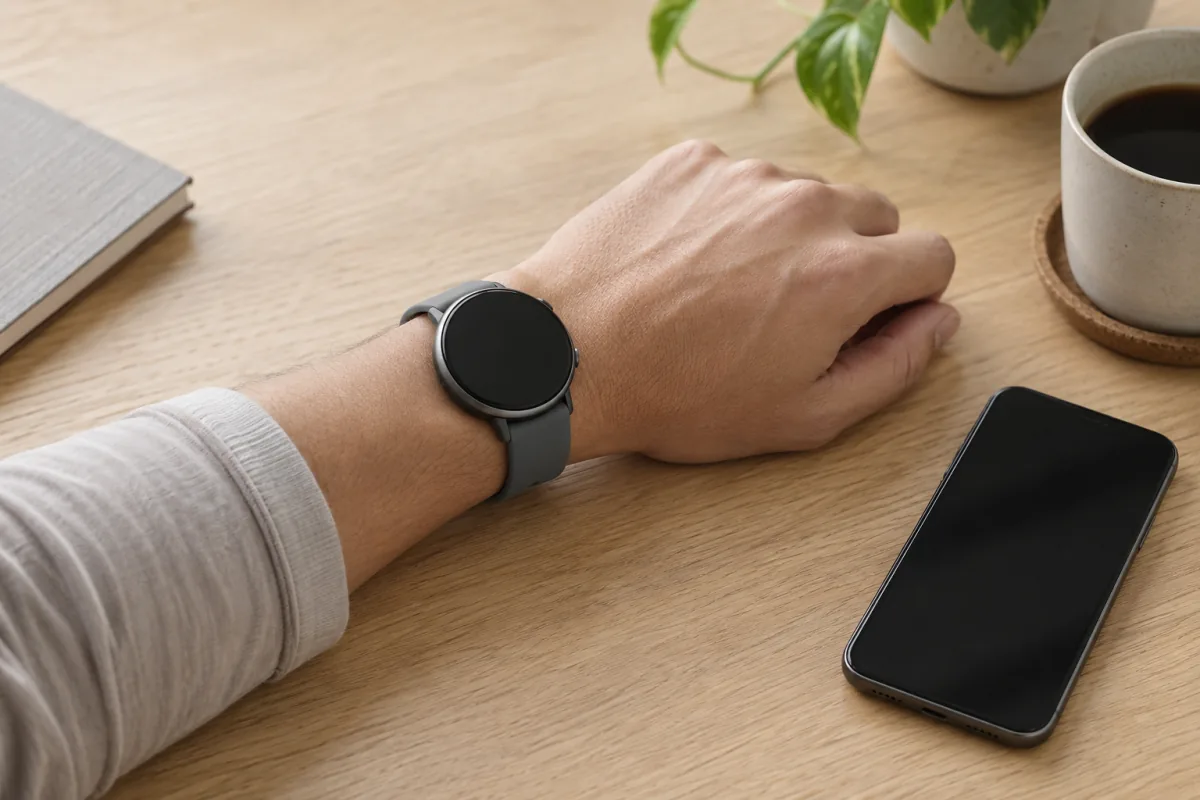
The right smartwatch depends on three things, in this order: which phone you carry, how many days you want between charges, and whether you care more about fitness tracking or about notifications and payments. Get the phone match wrong and nothing else matters, because an Apple Watch needs an iPhone and most Wear OS and Samsung watches lose features without an Android phone. This guide walks through those decisions, the features that justify a higher price, what the health sensors can and cannot tell you, and who should buy a simple fitness band instead.
Key takeaways
- Apple Watch is iPhone-only. Galaxy Watch and Pixel Watch need Android. Garmin, Amazfit, Huawei and most fitness bands work with both, with fewer phone features.
- Battery life ranges from about a day (full smartwatches) to two weeks or more (fitness-first watches). Decide which camp you are in before looking at anything else.
- Heart rate, sleep and blood-oxygen readings are wellness estimates, not medical measurements. ECG and irregular-rhythm alerts exist on some models but do not replace a doctor.
- Pay extra for GPS, a proper water rating and a bright screen. Skip LTE unless you run or cycle without a phone.
- A fitness band costs a fraction of a smartwatch and covers steps, sleep and heart rate for most people.
Phone compatibility decides half the choice
Apple publishes it plainly: an Apple Watch requires an iPhone, and the pairing, app installs, cellular setup and updates all run through it. The Apple Watch and iPhone compatibility page lists the minimum iPhone and iOS version for each watch generation. There is no Android app.
On the other side, Samsung’s Galaxy Watch line and Google’s Pixel Watch run Wear OS and pair only with Android. Samsung adds a further layer: ECG and blood-pressure features on Galaxy Watches work only with a Samsung phone in most markets. Other Wear OS watches from Mobvoi, OnePlus and Fossil-era brands are Android-first, with older models keeping a limited iPhone mode.
The cross-platform group is Garmin, Amazfit, Huawei, Fitbit’s older bands, Withings and most budget watches. They pair with either phone through their own app. The cost is fewer phone features: on an iPhone, you cannot reply to messages from these watches, and some notifications arrive late. If you switch phones every few years, a cross-platform watch survives the move. If you are settled on iPhone, the Apple Watch integration is hard to beat, and the same goes for a Galaxy Watch on a Samsung phone.
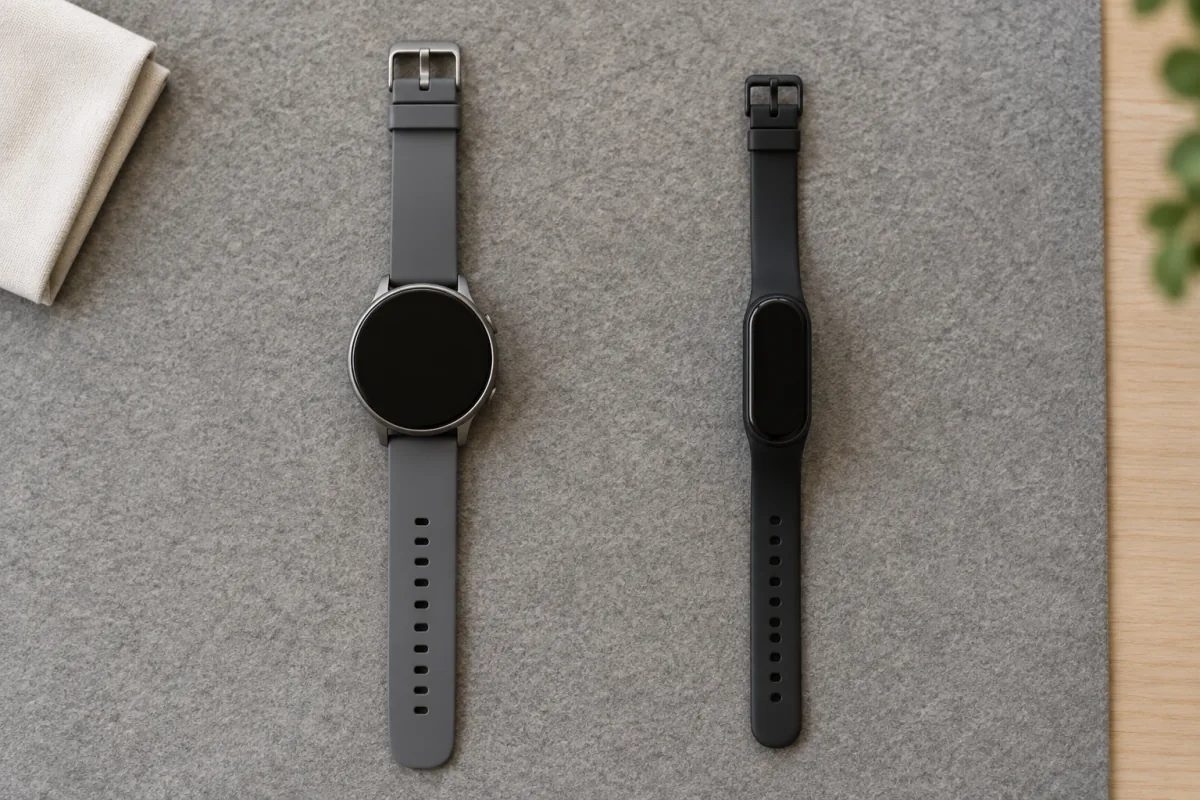
Smartwatch vs fitness band
A fitness band (Xiaomi Smart Band, Fitbit Inspire, Garmin Vivosmart, Huawei Band) tracks steps, heart rate, sleep and workouts, shows notifications you cannot answer, and runs a week or two on a charge. It costs roughly a fifth to a third of a mid-range smartwatch at the time of writing.
A smartwatch adds a bigger screen, apps, voice assistants, contactless payments, music storage, and on some models calls and LTE. Battery drops to one to three days. The honest question is whether you will use those extras. If your answer is “notifications and step count”, a band does the job and you will never think about charging it. If you want to pay for coffee from your wrist, leave the phone at home on a run, or follow a map on a hike, you need the watch.
Features by importance
Battery, in days not hours
Ask for the always-on-display figure, because the “up to 18 hours” or “up to 40 hours” a brand quotes usually assumes the screen sleeps. Full smartwatches (Apple Watch, Pixel Watch, Galaxy Watch) land at one to two days with regular use and workouts. Fitness-focused watches with transflective or low-power screens (most Garmin models, Amazfit, Coros) run a week to a month. There is no middle ground yet, so this line divides the market.
Screen
OLED screens are bright, colourful and use more power. Memory-in-pixel screens, used by many Garmin models, are dim indoors but readable in direct sun and sip power. Peak brightness of 1,000 nits or more matters if you run outdoors; 2,000 nits is the top of the range at the time of writing. A sapphire crystal costs more and resists scratches far better than mineral or aluminosilicate glass, which is worth it if the watch will meet door frames and weights.
GPS
Built-in GPS records a run or ride without the phone. Dual-band (L1 and L5) GPS holds a lock better between tall buildings and under trees, and is now common on mid-range and up. Watches without GPS borrow the phone’s, which is fine if the phone is always with you.
Heart rate and blood oxygen
Every modern watch has an optical heart-rate sensor. Accuracy is good at rest and during steady running, worse during weightlifting, cycling on rough roads and anything with sharp wrist motion. Blood-oxygen (SpO2) readings on the wrist are a trend indicator, not a clinical number.
ECG and rhythm alerts
Some watches (Apple Watch Series 4 and later, Galaxy Watch, Pixel Watch, some Withings and Garmin models) can take a single-lead ECG and flag possible atrial fibrillation. Availability depends on regulatory clearance in your country, so a feature listed on a global spec sheet may be greyed out where you live. The US Food and Drug Administration has published guidance on pulse oximeter accuracy and limitations, and the same caution applies to wearables.
Water rating
Look for 5 ATM (50 metres) for swimming and showers. “Water resistant” or IP67 alone means splashes and rain, not laps. Hot water, soap and saltwater shorten seal life, so rinse after the sea.
Payments
Apple Pay, Google Wallet, Samsung Pay and Garmin Pay all work at contactless terminals, but bank support varies by country and by brand. Check that your bank is on the watch maker’s list before assuming.
LTE
An LTE model has its own cellular radio for calls, messages and streaming without the phone. It costs more up front, needs a carrier add-on plan, and cuts battery noticeably when active. Worth it for runners and parents who want a child reachable without a phone. Not worth it if the phone is always in your pocket.
Price tiers at the time of writing
| Tier | Typical price band | What you get | What you give up |
|---|---|---|---|
| Fitness band | Lowest | Steps, heart rate, sleep, basic workouts, 1 to 2 weeks of battery | Apps, payments, GPS on most, replies |
| Budget smartwatch | Low to mid | Colour screen, notifications, often GPS, 5 to 14 days of battery | Payments in many regions, ECG, third-party apps, polish |
| Mainstream (Apple Watch SE, Galaxy Watch, Pixel Watch, Garmin Venu or Forerunner mid-range) | Mid | Full app support, payments, GPS, water rating, strong sensors | Sapphire glass, titanium, multi-band GPS on some, week-long battery on the Wear OS and Apple models |
| Premium (Apple Watch Ultra, Galaxy Watch Ultra, Garmin Fenix or Epix, Pixel Watch top trim) | High | Sapphire, titanium, brighter screen, dual-band GPS, dive or trail features, longer battery | Money, and size on smaller wrists |
The jump from budget to mainstream buys reliability: sensors that agree with a chest strap more often, apps that exist, and software updates for four or five years. The jump from mainstream to premium buys materials and outdoor features. Most people stop at mainstream.
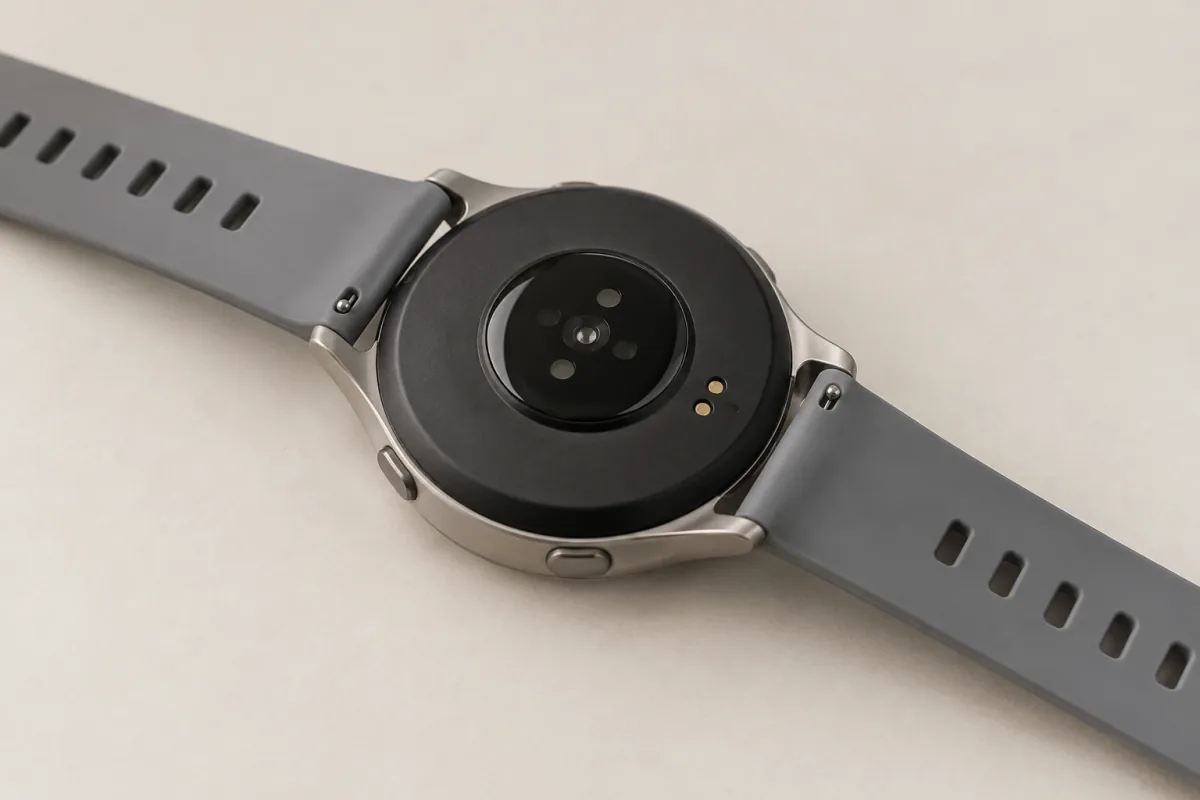
Health sensors: what they measure and what they do not
A watch measures light reflected from blood under the skin (heart rate and SpO2), movement (steps, sleep stages), skin temperature and, on ECG-capable models, the electrical signal between wrist and finger. From those it estimates calories, stress, VO2 max, sleep quality and readiness scores. Estimates is the right word.
- Sleep stages are inferred from movement and heart rate. Compared with a sleep lab, watches get total sleep time fairly close and individual stages much less so.
- Calorie burn is a formula based on heart rate, age, weight and height. Treat it as relative (today vs yesterday), not absolute.
- Stress and readiness scores use heart-rate variability. They are useful trends over weeks, noisy on any given morning.
- Blood-pressure features on some Samsung and Huawei watches need periodic calibration against a cuff and are not cleared as medical devices in most countries.
The manufacturers say this themselves: Apple’s Health app and Samsung Health both state that readings are not intended for medical use. If a watch flags an irregular rhythm or a low overnight SpO2 more than once, that is a reason to see a doctor, not a diagnosis.
Sizing, straps and durability
Case sizes run from about 40 mm to 49 mm. On a wrist under 15 cm around, a 40 to 42 mm case fits; over 18 cm, a 45 mm or larger case looks in proportion. Bigger cases usually carry bigger batteries, which is the one reason to size up.
Straps matter more than people expect. Silicone is fine for workouts and sweats under it for everything else. Nylon or fabric breathes and dries fast. Leather looks better and hates the shower. Check the lug width or proprietary connector before buying third-party straps; Apple and Samsung use their own systems, most Garmin models use standard quick-release pins.
Durability claims come in two flavours. An IP rating (IP68, for example) covers dust and water immersion at a stated depth for a stated time. MIL-STD-810 is a US military test method for drops, vibration, heat and cold; brands choose which of its tests to run, so “MIL-STD-810H tested” without a list of tests says less than it seems. Sapphire glass and a raised bezel do more for day-to-day survival than either label.
Who this is not for
If you already own a good mechanical or quartz watch and only want step and sleep data, a band on the other wrist, or a ring, is cheaper and less intrusive. If you do not want to charge anything nightly, rule out Apple Watch and Wear OS entirely and shop Garmin, Amazfit or a band. If you want a medical-grade monitor for a diagnosed condition, no consumer watch is that, and your doctor will point you to a proper device. And if your phone budget is tight, the money goes further on the phone; the site’s guide to budget phones shows how much watch-level features cost on the handset side.
Two related guides: pairing a watch with wireless earbuds for phone-free workouts, and the site’s explainer on Bluetooth codecs explained, which covers why music streamed from a watch sounds different from music streamed from a phone.
Frequently asked questions
Does an Apple Watch work with Android?
No. Setup, updates and most features run through the iPhone’s Watch app, and Apple provides no Android equivalent. An Apple Watch that has already been set up will keep time and run standalone apps, but it cannot receive notifications, sync health data or install anything from an Android phone.
How accurate is wrist heart rate?
At rest and during steady cardio, within a few beats per minute of a chest strap for most people. During interval training, weightlifting or activities with heavy wrist movement, it can lag or jump. Tattoos, dark skin, cold hands and a loose strap all reduce accuracy. Wear the watch snug, one finger above the wrist bone, and treat the numbers as trends.
Do I need LTE on a smartwatch?
Only if you regularly leave the phone behind and still want calls or messages. It adds a monthly carrier fee in most countries and drains the battery faster when active. Music and maps can be downloaded to the watch over Wi-Fi without LTE.
How long do smartwatches last?
Three to five years for the hardware, limited mostly by battery wear and software support. Apple and Samsung typically update watches for four to five years; Garmin offers fewer feature updates but the watches keep working. Batteries lose capacity gradually, and a watch that ran two days new may need daily charging by year three. Replacement batteries are possible on some models but rarely cheap.