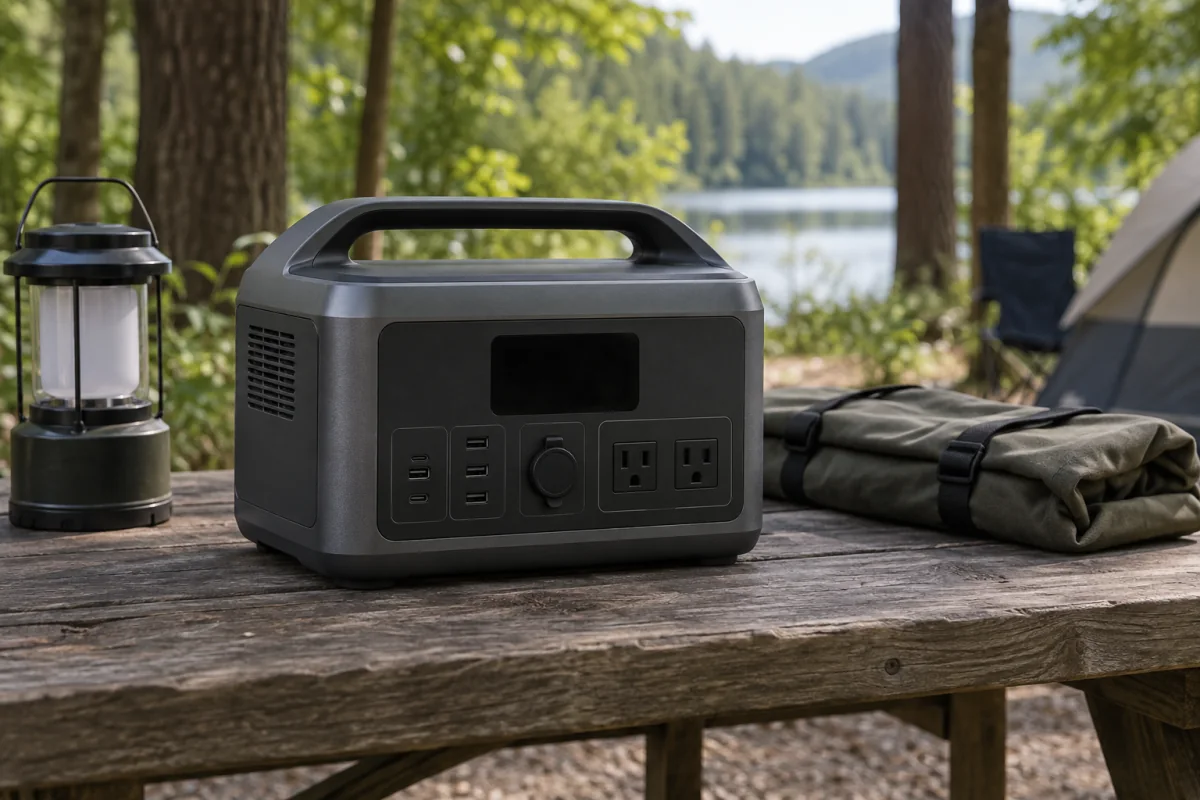
The right portable power station depends on one number: the watt-hours you need to get through your worst realistic day without mains power. A 300 to 500 Wh unit keeps phones, laptops and a router alive through a weekend of camping. A 1,000 to 1,500 Wh unit runs a fridge through an overnight outage or a full day of working from home. Anything past 2,000 Wh is entering whole-home backup territory and costs accordingly. This guide shows you how to size one, which specs are worth paying for, how to charge it, and when a cheaper option does the job.
Key takeaways
- Size by watt-hours (capacity), then check the output watts (what it can run at once). Both matter.
- LiFePO4 (lithium iron phosphate) batteries last several times longer than older lithium-ion packs. For anything you’ll keep for years, insist on it.
- A typical fridge draws 100 to 200 W while running, so a 1,000 Wh station covers roughly 10 to 14 hours of fridge time.
- Solar panels are worth it only if you’re regularly off-grid for days. For outage backup, wall charging is enough.
- Expect a low-to-mid three-figure price for 300 to 500 Wh, high three figures to low four figures for 1,000 to 2,000 Wh, at the time of writing.
Capacity: work out your watt-hours
Watt-hours (Wh) tell you how much energy the battery stores. Work out what you need in four steps.
- List what you’ll run. Check the label on each device or use a plug-in power meter.
- Note the running watts of each and how many hours per day it will run.
- Multiply watts by hours for each device, then add them up.
- Add 20 percent for inverter losses and the fact that you can’t drain the battery to zero.
| Device | Typical draw | Hours from 1,000 Wh |
|---|---|---|
| Phone charge | 10 to 20 Wh per full charge | 50+ charges |
| Laptop | 30 to 65 W | 13 to 27 hours |
| Wi-Fi router plus modem | 10 to 20 W | 40 to 80 hours |
| Full-size fridge | 100 to 200 W running (cycles on and off) | 10 to 14 hours realistic |
| CPAP machine (no heated humidifier) | 30 to 60 W | 2 to 3 nights |
| Electric kettle | 1,200 to 1,800 W | Around 30 boils, but only if output rating allows it |
Output: what it can run at once
The continuous output rating in watts is the ceiling for everything plugged in at the same time. A 600 W station can charge a laptop and run a router and a fan, but it will shut off the moment you plug in a kettle. Look at three figures on the spec sheet:
- Continuous AC output. This is the one that matters. 500 to 800 W covers electronics. 1,500 W or more handles small appliances and power tools.
- Surge or peak output. Motors (fridges, pumps, drills) draw two to three times their running watts for a moment at start-up. The surge rating needs to cover that.
- Pure sine wave. Nearly all current models have it. Check anyway if you’ll run medical equipment or anything with a motor.
Battery chemistry: why LiFePO4 wins
Two chemistries dominate. Older lithium-ion (NMC) packs are lighter and cheaper per watt-hour, but are typically rated for 500 to 800 full charge cycles before capacity drops to 80 percent. Lithium iron phosphate (LiFePO4 or LFP) packs are rated for 3,000 cycles or more, run cooler and are more tolerant of being left partly charged. If you’ll cycle the station daily for solar or van use, the difference is years of life. For an outage box that sits at 80 percent most of the year, either chemistry is fine, but LFP still ages better in storage. Manufacturers state cycle life on the product page; EcoFlow’s spec pages, for example, list the cycle count next to the chemistry, and it is worth reading before comparing prices.
Charging: speed and sources
Wall charging
Modern units with a built-in charger refill from empty to 80 percent in one to two hours. Older or cheaper units with an external power brick can take six to eight hours. If you’re buying for outages, fast wall charging matters more than solar, because you want to top up quickly when power flickers back.
Solar
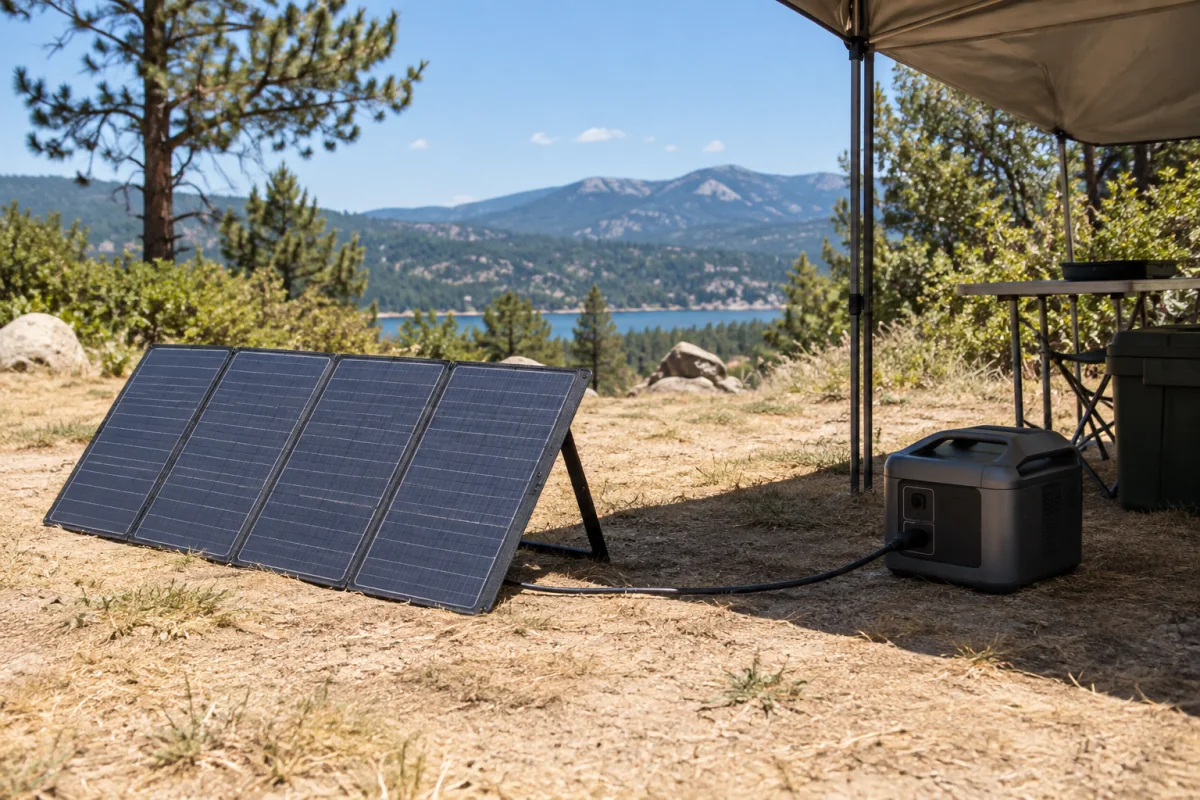
Check the maximum solar input in watts and volts. A 1,000 Wh station with 200 W of panels in good sun takes five to seven hours of real sunlight to refill, and that assumes clean panels pointed correctly. Cloudy or winter conditions halve that. Buy the manufacturer’s own panels or ones with the right connector (usually MC4 to XT60 or Anderson) and a voltage that stays under the station’s limit.
Car charging
The 12 V socket in most cars gives about 100 W, so it’s a trickle. Useful for topping up a small station on a long drive, not for refilling a large one.
Ports and features that matter
- USB-C Power Delivery at 100 W. Charges a laptop without dragging its brick along. Some units offer 140 W.
- Multiple AC outlets. Three or more saves carrying a power strip.
- Uninterruptible power supply (UPS) mode. The station passes mains power through and switches to battery when the mains drops. Switchover time of 20 ms or less keeps a desktop PC or a router from rebooting. This alone justifies a station for a home office.
- An app that lets you set charge limits. Charging to 80 percent for everyday use extends battery life.
- Expandable batteries. Some lines let you add a second pack later, which is cheaper than buying a bigger unit from the start.
Sizing by use case
Camping and weekends
300 to 600 Wh. Phones, a camera, lights, a small fan, and a laptop for an evening. Look for something under 8 kg with a carry handle. Solar is optional; a car charge on the way there usually suffices.
Home office and power outages
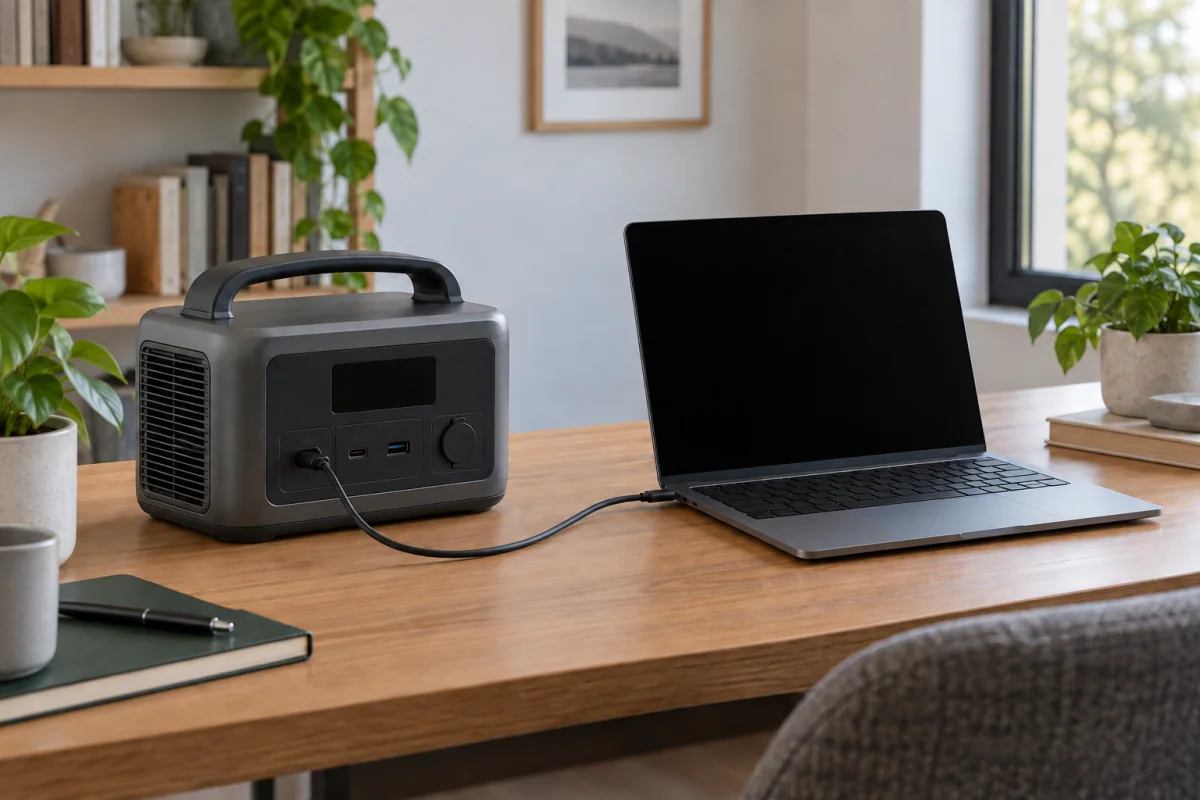
1,000 to 1,500 Wh with UPS mode and at least 1,500 W output. This keeps a router, monitor, laptop and lights going for a working day, or a fridge overnight. Pair it with a low-draw monitor and you’ll stretch it further than you expect. Fast wall charging matters here. If the laptop is the main load, the laptop guide notes which models sip power.
Longer outages and whole-home backup
2,000 Wh and up, 2,400 W or more output, with expandable battery packs and a transfer switch installed by an electrician if you want to feed house circuits. This is a real project with real cost, and worth comparing against a standby generator.
Safety and storage
Power stations are safe indoors because they produce no exhaust, which is the main reason to prefer them over a petrol generator during a storm. A few rules keep them that way.
- Don’t charge in a hot car or in direct sun. Most units refuse to charge above about 45 °C.
- Store at 50 to 80 percent charge and top up every three months if unused.
- Keep vents clear. Fans need airflow when the inverter is under load.
- Check the product carries a recognised safety mark (UL 2743 is the standard for portable power stations in North America; the UL site explains what the listing covers).
- Airlines cap lithium batteries in carry-on at 100 Wh without approval and 160 Wh with it, so no power station of useful size flies. Check the FAA PackSafe rules before travelling.
Common mistakes
- Buying on capacity alone and discovering the output can’t start the fridge compressor.
- Assuming solar will refill a big station in a day. Real-world panel yield is often half the sticker rating.
- Draining it to zero and leaving it there for months. Cells degrade fast when stored empty.
- Paying for 3,000 Wh when a weekly outage never lasts more than four hours.
Who should not buy one
If your goal is to keep a whole house running for days, a properly installed standby generator or a home battery is a better fit and a portable station will frustrate you. If you only need to keep a phone alive, a 20,000 mAh power bank at a fraction of the cost does that. And if you live somewhere with reliable power and never camp, the money is better spent on a small UPS for the router and PC. A power station is right when you want silent indoor backup for a room’s worth of gear, or reliable power away from mains for more than a day. For the security side of an outage, the solar security camera guide covers cameras that keep recording when the power goes.
Frequently asked questions
How long will a portable power station run my fridge?
A typical full-size fridge averages 100 to 150 W over an hour once cycling is accounted for. A 1,000 Wh unit gives roughly 10 to 14 hours if nothing else is plugged in and the door stays shut.
Are portable power stations safe indoors?
Yes. They produce no fumes. Keep them ventilated, away from heat, and use models with a recognised safety certification.
Can I use it while it’s charging?
Most current models support pass-through charging. The unit may charge slower while under load, and constant pass-through use warms the battery, so it is best reserved for UPS duty rather than everyday use.
How many years does one last?
An LFP unit at 3,000 cycles lasts eight to ten years of daily use. An older lithium-ion unit at 500 cycles used daily will fade noticeably within two years. Occasional outage use extends both a lot.
Is it worth getting solar panels?
Only if you’ll be away from mains for several days at a time. For outage backup, wall charging and keeping the station topped up is simpler and cheaper.
Can a portable power station power my whole house?
Not on its own. Large units with a transfer switch can run selected circuits like the fridge, lights and a furnace fan, but central air conditioning and electric water heating exceed what a portable unit provides for long.